
Two Crowns, One Monarchy

This is a companion piece to our recent podcast episode on the Catholic Monarchs. Listen here:
Everyone "knows" that Isabel of Castile and Fernando of Aragon united Spain when they married in 1469. It's one of history's most famous political marriages—the union of two powerful rulers that created a nation destined to dominate Europe and build a global empire. But this well-known story is wrong, or at least significantly incomplete. The marriage united two rulers, not two kingdoms. Spain remained largely divided during the reigns of Isabel and Fernando, and this carefully maintained separation shaped Spanish governance for centuries. Recognizing this reality helps explain what historians now see as the main pattern of early modern European governance: composite monarchies like the Ottoman Empire, Holy Roman Empire, Poland-Lithuania, and the British kingdoms operated as territorial conglomerates under single rulers who maintained high levels of political, judicial, and cultural diversity instead of pursuing the uniformity seen in later nation-states.
The legal framework set for Isabel and Fernando's joint rule shows the limitations of their "union" from the very start. The 1469 marriage contract, later supported by the 1475 Segovia concordat, made it clear that Isabel was the only legitimate ruler—the reina propietaria (Queen Proprietress)—of Castile. Fernando acted as her consort in Castilian matters, though both signed documents. When Fernando inherited Aragon from his father in 1479, he became king of that separate kingdom in his own right. This created a personal union: two crowns worn by the same couple, but still two crowns nonetheless.
This was more than just a legal formality. According to historian John Edwards, Castile and Aragon were like two different worlds in many ways—each with its own institutions, social and economic setups, currency, and language. Castile had already unified its kingdoms—León, Toledo, Galicia, Seville—losing their individual identities long ago, as Edwards points out. It had a single royal system, one parliament (the Cortes), and relatively centralized governance. On the other hand, Aragon stayed very much a collection of separate parts, including kingdoms like Aragon, Valencia, and Naples, as well as counties like Catalonia and the Balearic Islands, and territories such as Sardinia and Sicily. Each of these areas fiercely protected its own laws, legislative bodies, and tax systems. Edwards notes that Fernando had almost no centralized power—either legislative or political—over these diverse territories.
The marriage agreements themselves clearly prevented any forced integration, emphasizing respect for mutual sovereignty. Violating these would have shaken the very foundation of Isabel and Fernando's joint leadership, which everyone relied on. More deeply, Castile didn't see the need to 'unify' with Aragon—it was already a strong, independent entity. With about five times Aragon's population and annual revenues reaching 320 million maravedís by 1510, Castile was the robust military and financial support system behind the rulers’ ambitions. Fernando himself often told the Catalan Corts that Castilian resources were crucial for defending and expanding the Crown of Aragon.

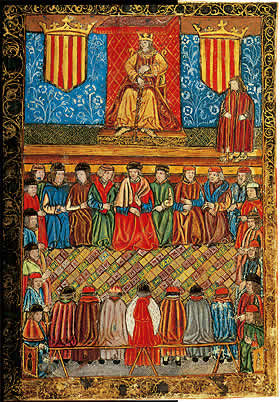
If any doubt lingered about the separate nature of the two realms, the landmark Cortes of Toledo in 1480 made it clear. This parliament session—the most productive of the Catholic Monarchs' entire reign—laid the institutional groundwork for their governance. Among the specialized councils established was a separate Council of Aragon, staffed by knights and letrados (university-trained lawyers) native to Aragon, Catalonia, Sicily, and Valencia, handling affairs from those kingdoms.
This Council of Aragon met alongside the Council of Castile, usually on Castilian soil, since the monarchs spent most of their time there, but it remained institutionally separate. Both councils reported to Isabel and Fernando, but they governed mainly different realms with distinct laws and privileges. The chronicler Pulgar observed that "in that Cortes of Toledo, in the royal palace where the King and Queen stayed, five councils sat in five apartments"—a physical representation of governmental division.
This arrangement was neither temporary nor transitional. The dual council system, with distinct institutions for Castile and the Crown of Aragon, lasted until the Nueva Planta decrees of 1707-1716, when the Bourbon dynasty finally imposed Castilian institutions on Aragon after the War of Spanish Succession. For more than two centuries, Spain operated as what the historian J.H. Elliott called a "composite monarchy."
The institutional differences showed how varied political cultures influenced what reforms the Catholic Monarchs could carry out. In Castile, efforts toward centralization went very well. The revamped Royal Council prioritized university-educated lawyers over hereditary nobles. The Act of Resumption recovered around 30 million maravedís in annual earnings that had been improperly handed out. Corregidores—royal officials—were systematically assigned to all cities and major towns, ensuring direct royal oversight of local governments. Additionally, the Santa Hermandad evolved from local militias into a kingdom-wide police force and military recruitment system under royal supervision.
These Castilian reforms succeeded partly because Castile had a longer history of centralization and weaker traditions of constitutional resistance. When confronting royal authority, Castilian nobles and cities might resist locally or delay compliance, but they lacked the institutional frameworks and ideological traditions to mount sustained opposition. Isabel's absolutist instincts—evident when she told Segovia's delegates in 1476 that she would tolerate no questioning of her authority as queen of Castile—found fertile ground.

Aragon offered a markedly different landscape. Its political culture centered on pactismo—a form of contractual constitutionalism in which the monarch governed through negotiation and consent, acting, as Edwards terms it, "first among equals" rather than an absolute ruler. Upon Fernando's inheritance of Aragon, he encountered institutional barriers absent in Castile. The Constitució de l'Observança (1481) required him to officially acknowledge all Catalan privileges and rights. The Aragonese Cortes, made up of four estates fiercely defending their constitutional rights, remained, as historian J.N. Hillgarth describes, "parsimonious, distrustful, and suspicious," demanding redress of grievances before offering support. Even Isabel, as Edwards notes, found them "far more jealous of their constitutional rights than their Castilian colleagues" when she led the Zaragoza cortes in 1481.
The practical failures of Castilian-style reforms in Aragon revealed these fundamental differences. The Hermandad—so effective in Castile at establishing order and royal authority—failed dramatically in Aragon. When the institution tried to act against a noble in 1488, the Aragonese nobles rebelled. The Hermandad was abolished de facto in 1488 and de jure in 1495. The same institution that had shown it could expand royal justice throughout Castile couldn't overcome Aragonese constitutional traditions and noble resistance.
The nobility of Aragon proper—distinct from the more urban elites of Catalonia and Valencia—remained, according to Edwards, "defiant of royal authority for many years to come." They controlled the Cortes, maintained dominance over dependent peasants, and engaged in private wars throughout Fernando's reign, despite attempts at reform. In 1513, a private conflict between noble families even extended from Aragon into Catalonia, despite royal efforts to prevent it. This led contemporaries to see the kingdom as politically paralyzed—Aragon neither adopted Castilian-style reforms nor provided substantial support to the crown's broader initiatives.
Fernando's response to these limitations reveals a notable aspect: he did not make a significant effort to bypass them. During his 37-year reign, he spent less than three years in Aragon and under three in Catalonia. His governance of the Crown of Aragon was carried out through viceroys and lieutenants, accepting constitutional restrictions that would have been unimaginable in Castile. When the Aragonese Cortes declined to grant a subsidy in 1515, the chronicler Zurita recounted Fernando's anger at their stubbornness—but he ultimately accepted their decision. This situation stands in stark contrast to Castile, where the Cortes had been largely sidelined due to reforms in 1480 and were now summoned only for ceremonial purposes.

If political and institutional unity proved challenging to achieve, religious uniformity provided an alternative unifying force—one that went beyond territorial borders because it operated on different principles. The Spanish Inquisition, authorized by a papal bull in 1478 and active by 1480, became the only institution with jurisdiction across both Castile and Aragon. Unlike other inquisitions that operated under papal or episcopal authority, the Spanish Inquisition reported directly to the crown. Isabel and Fernando made all appointments. When Pope Sixtus IV condemned the Inquisition's excessive brutality in 1482, he found he couldn't actually control it.
This institutional innovation proved highly effective as a centralizing force because it crossed the political boundaries that monarchs were otherwise required to honor. A converso suspected of secretly practicing Judaism faced the same inquisitorial procedures whether arrested in Seville or Barcelona. The Inquisition's consistency stood in stark contrast to the diversity of laws, taxes, and governance within the composite monarchy. Religious orthodoxy became closely tied to Spanish national identity, with Catholic conformity pursued both as a spiritual duty and a practical way to ensure political unity where constitutional unity was impossible.
The Inquisition's unique jurisdiction served as an exception that proved the rule: because it could operate uniformly across all territories, it showed how rare such consistent jurisdiction was. Every other institution—councils, courts, taxation systems, municipal governments—remained limited by the separate legal identities of each territory. The Inquisition thrived as a unifying force because it operated outside and above the political divisions separating Castile from Aragon.
Understanding Spain as a complex monarchy rather than just a unified nation helps us see beyond a simple historical mistake. The system set up by Isabel and Fernando became the model for the Spanish Empire. When Spain added new lands like Naples, Navarre, and the vast American territories, each was kept as a separate entity under the same ruler, rather than becoming one single centralized country. The Council of the Indies, created in 1524 to oversee America, followed the same approach as the Council of Aragon: different institutions for each region, all ultimately loyal to the king but keeping their individual identities.
This flexibility proved both a strength and a weakness. It enabled Spain to govern highly diverse territories without enforcing uniform institutions that could trigger resistance. The empire adapted to regional differences, linguistic diversity, and local privileges—what Elliott referred to as governing through "pacts" rather than centralized control. This approach made Spanish imperial rule more sustainable in some ways than more forceful centralization efforts.
But the same structure that allowed expansion also created lasting tensions. The composite monarchy remained until the Bourbon dynasty, after winning the War of Spanish Succession, finally enforced centralization with the Nueva Planta decrees (1707-1716). Even then, and to this day, Spain's regional tensions have roots in the medieval and early modern structures that Isabel and Fernando chose to preserve rather than dismantle. Catalan, Basque, and Galician regional identities trace their institutional memories back through the composite monarchy to the separate kingdoms that never fully unified.
The Catholic Monarchs' achievement was not so much in unifying Spain as in creating a flexible and effective system for managing diversity. They established institutions that conveyed royal authority while respecting regional differences, enforced religious uniformity where political unity was difficult, and devised administrative methods adaptable for expanding from the Iberian Peninsula to a vast global empire. Whether this was the result of careful planning or practical responses to circumstances beyond their control is still debated. What is certain is that understanding the Spanish Empire—and how early modern empires generally functioned—means moving beyond romanticized ideas of unified nation-states and instead recognizing the complex, negotiated, and diverse realities that truly existed.
Spain was not united in 1469, 1480, or 1504. Two crowns remained two crowns, even when held by the same couple, and the institutional structures that supported that division influenced Spanish governance and imperial rule for centuries.
Further Reading:
The Spain of the Catholic Monarchs 1474-1520 by John Edwards


I enjoyed reading this article because it covered important moving details that are often overlooked. A dependable fragile moving service can make all the difference when transporting delicate valuables.